Tango History
Birth and Beginnings
Tango Terms & Etymology
Great Tango Tragedies
Carlos Gardel
La Cumparsita
 
 
ToTANGO Dancers
 
 
On Dancing Tango
Floorcraft
Why Tango? - A Leader
Why Tango? - Followers
Tango Gender Equality
Keys to Tango
Women & Milonguero Style
The Milonga Experience
Tango Talk - Our Interviews
The Tango Junkies
Dancing In The Moment
Art of El Cabeceo
 
 
Dancers / Teachers
Escuela De Milongueros
Osvaldo Zotto & Lorena
Miguel Angel Zotto
Fernanda & Guillermo
Carlos Gavito
Diego & Carolina
Fabián Salas & Carolina
Pablo Veron & Noel Strazza
Chicho & Lucía
Gustavo & Giselle
"El Pulpo"
Juan Carlos Copes
Maria Nieves
Eduardo & Gloria Arquimbau
Fabián & Roxana
Noche de los Milongueros


    Search ToTANGO:


email Keith
 
 
    Click for Buenos Aires Forecast
ToTANGO.net


  Keith Elshaw's      Tango Weblog          Since 1997  

ToTANGO


ToTANGO Re-Mastering Series Update
Oh, What Joy In Hearing The Hits Newly Cleaned


Summer has officially arrived here in the land of party-your-pants-off deep in warm cultures. Last night (June 30), Stevie Wonder opened the Montreal Jazz Festival in with a free outdoor concert downtown with over 100,000 people jumping in the streets. Montreal is some kind of city.

This summer of 2009 is exciting for me personally, as I've reached a milestone which has been my quest for 8 years. To wit:

To get my tango restoration work to the point where it is starting to be definitive in some areas. So I'm told.

Lest this sound boastful, let me assure you it's not a claim I will make for the forseeable future (well - I'll never make it myself).

But I would like to share with you some of the excitement I feel with the revelations coming out of all the re-mastering I've been doing.

Just one example:

Technological advances have given me new tools as of the last few months. Songs I've had in my library for years that I love were not in my playing catalogue because they were just technically not up to a comfortable listening standard. Now, just in the last few weeks, I've been able to restore hundreds (that's right) of tracks so that they sound clean and crisp.

This has made things a lot more fun for me the tango nut. To explain what I mean, let's talk about Di Sarli.

He recorded a few songs a two and three times. They all sound different. But, the quality of the commercial recordings being what they are, you usually end up using the best version you have.

I'm now really enjoying being able to play "De Vuelta" by Podesta OR Serpa; Duello Criollo by Duran OR Pomar. Di Sarlis great instrumentals all 3 versions he made over time when he did that. All without noise no matter in what year he recorded them. It's really a treat to recover things not playable before.

Of course, not only are there multiple versions of the same songs recorded at different times, there are different record company released of the SAME version which all sound radically different in quality. One has to sort through these to find the best and truest. One more reason the restoration task in a process - not something you can do once and then forget about.

More before-and-after samples coming soon (when I can tear myself away from the heat of rendering new restorations).

Let's listen to a portion of Siete Palabras by Maestro Carlo Di Sarli, recorded August 29, 1945.

This is what it sounds like on a commercial CD I purchased.

This is what it sounded like after I cleaned it but before Mastering. (Source was from a transfer of the 78 on an lp (33 1/3) released in 1968. Still scratchy, but nicer underneath the noise than what the CD offered. I'm a big analog fan (notice the strings are sweeter sounding? - even though I work in the digital realm). (Thanks to my beloved ex-sister-in-law Maria Nieves for giving me her record collection)!

This is what it sounds like after Mastering my cleaned rendering. (Of course, the better the speakers you listen on, the more difference you will hear).

Always ringing in my ears are the comments I've heard from new people to tango who say, "Why do you like that old music?"

My answer is to make it sound more like it was recorded yesterday so they can hear how great it is. I'm seeking to add dimension, clarity and warmth - so it's like the orchestra is in the room with you. Or we are there with them when they recorded.


-------

Osvaldo Pugliese's El Arranque (1944) commercial CD version.

Let's say I wanted to clean that by running it through my sophisticated computer software. This is what it would sound like (notice there is still noise, even though I've got it cranked. And the music doesn't sound like music any more (what I call the garden-hose effect). And the level is really low even though I've cranked that up, too. Please turn your monitors back down before you play the next file).

Now here is the ToTANGO cleaned and re-mastered version. (You wouldn't believe how long I sweated over the first 10 seconds. Took forever and drove me crazy - but makes me smile every time I hear it now. To a tango dancer, that's a god there playing the piano; and to me one also in the first bandoneon chair).


------

For me, it isn't just about taking noise away - it's every bit as much about making the sound round and more listenable; so that when you turn it up, it doesn't give you a headache.

Anibal Troilo's Yo Soy El Tango commercial CD version(March, 1941).

The new ToTANGO version.


ToTANGO Digital Tango Restorations
31¢ per song and less!

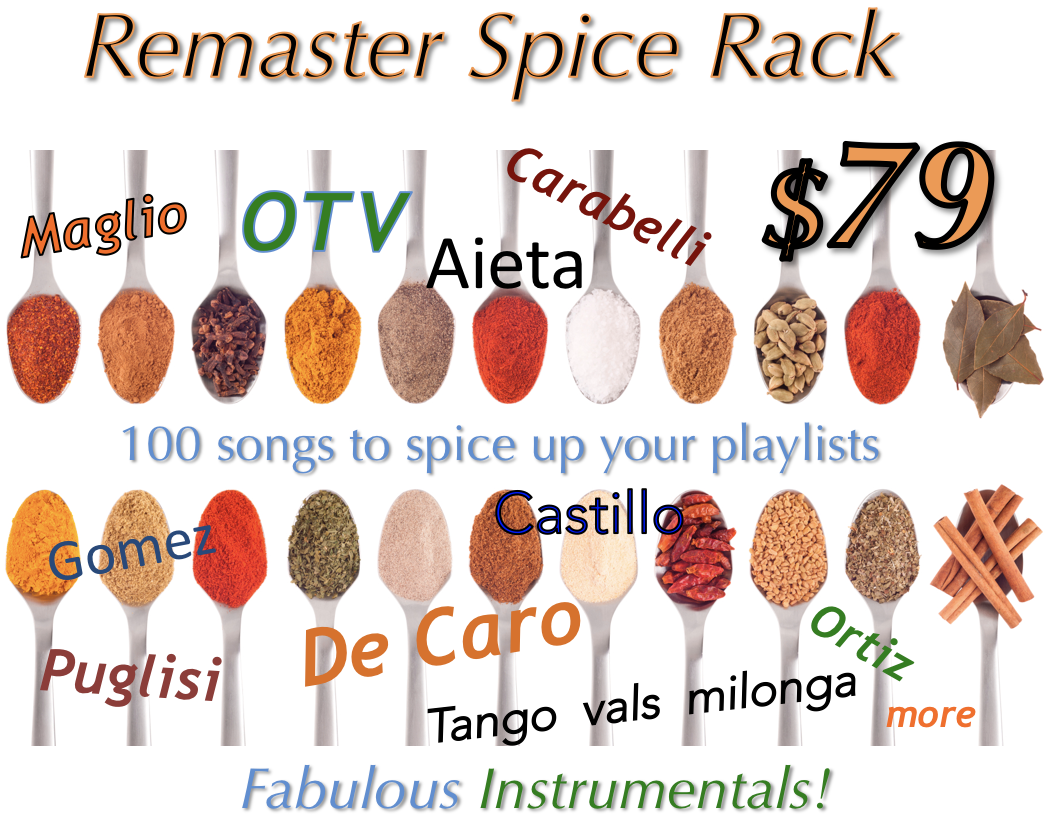
Imagine holding a few DVD's in your hands or a small drive in your hands, plugging it into your computer or iPod, and up pops 2,000 tangos, vals, milonga for dancing - newly restored, enhanced, crystal-clear Argentine Tango by all the greats. No annoying noise, scratches or clicks!

(Also available on CD)


read more


ToTANGO
 

Mailbag
Comments about ToTANGO Restorations 3.0

(I always ask permission to use comments/names).


From Denmark:

Hi Keith,

The 3 Tango DVD-ROMs arrived today without any problems.

I'm happily listening to some of my favourite Tangos in these new and vastly improved versions, as I type this.

Excellent work! You have really managed to let the magic of these musicians shine once more, untarnished by the flaws and imperfections imposed on them by time and inferior sound equipment.


And also a huge 'Thank You' for the additions, it's good to know you are still adding to the catalogue.
Yours,
Johnny Oreskov
(One very satisfied customer!)

From Marcos Christodoulou in California:

I'm sorry for not writing sooner. The drive arrived promptly, I think a week to the day since you shipped it, but I've been busy, both with work and other chores, and with enjoying its contents, and so meant to write sooner but didn't get to it.

I love it! The quality, the selection, the size of the collection, everything. I'm not into genres other than solid, traditional Argentine period gems, and there's plenty of that to keep me very happy for a very long time! Thank you.

Let me know if you make updates to the selection.

Marcos


---------------------


From Johan Steyn:

Sure - no problem - go ahead. And I don't mind if you identify me by name - word is already spreading here in Ireland about your fine music that I use to DJ with :)

A big thank you from me too. I managed to compile a few tandas from your music in time for the Cork Tango Festival - and it went down very well with the dancers. I was quite nervous initially, as I was lined up to DJ in front of some very good, experienced Argentinian dancers and teachers, some of whom are Tango DJ's themselves. I got some good feedback from them - which will result in a few changes - and some comment on aspects that they really liked. Most importantly: they danced to the music almost the entire evening.

BTW, I noticed that all comments I received from dancers are about choices: the compilation of tandas, the ratio of T/M/V tandas, the choice of cortina(s), etc. No-one ever comments about the sound quality. I guess people probably assume that if it sounds good, then it is due to good equipment or the acoustics of the room, or that they simply perceive it as better due to their good moods (tired ears don't listen well). Whatever the reason - I guess that both the choice of music, and the quality of the sound affect the number of dancers on the floor, and in that regard the milonga was a success: your music is very danceable, it sounds good, and the dancefloor was never empty.

It is an absolute joy working my way through your music - compiling tandas while savouring the delights. I have worked my way halfway through the Canaro tracks, and through all the D'Arienzo and Fresedo tracks - there are some real gems among them. I think I'll tackle Di Sarli next (never been a huge fan - but I've never listened to his older recordings - so I hope to have my mind changed), and then move on to some lesser-known leaders like Donato, Malerba, Lomuto, etc.

And, as I predicted: I'm not getting much sleep in ;)

Cheers,
Johan

---------------------

From closer to my home, Vernon Willis. Vernon and his partner Sandra are tango students of mine and have punished themselves even further by freqently inviting me to their home for dinner - providing me with a wonderful chance to hear what I've done through someone else's system and perception. Being educators themselves, they took an approach to getting to know my catalogue that really endears them to me: they put themselves on a project to listen to absolutely EVERY one of the nearly 1,700 songs in my Restoration catalogue before making their owns choices for what they wanted to hear. They kept notes over the several months it took in available time. Part of their credibility comes from their tendency toward understatement. They decided they wanted to send notes seperately. Double my pleasure!

Hi Keith

On March 17, 2009, at 10:44 pm we finished the project by playing Tanturi's Recuerdo (vals).

It was an incredible experience. I can't remember getting up to adjust the volume but I may have once or twice.

The songs were chosen at random and not once were we unsatisfied with what we had chosen.

Take care.

Vern


ToTANGO


"It Takes Two" (Another Take)
Tango & Jazz

Music means SO much to a person alive. It certainly has to me. In so many ways, so many forms, always.

To say that my life changed drastically and forever when I discovered Argentine Tango is mild understatement. At one and the same time, it gave me a new life while simply allowing me to get in touch with who I am and had always been. On multiple levels.

How much the "discovery" of the New World changed life on the planet. I've always enjoyed moments of contemplation of the 2 Sublime forms of music that the New World then created and gave back; and they both came about in the same way and at the same time: Tango and Jazz.

Two great cities at the mouth of 2 great rivers which drained much of both continents. Port cities inhabited by immigrants from all over and constantly visited by ships carrying more. In touch because of the sea - how the world worked then. Facilitating growth and sustenance. Blending; seething; incubating, developing. Brazen, profane, creative, profound. Finding a way to make life's sorrows feed life's possibilities and the hungry human spirit everywhere.

And in those two great cities, unlike any other, music and culture was born which changed the world.

New Orleans. Buenos Aires.


Do you remember the first book you ever read that made you fall in love with words, stories, information - the outside world - that gave you a thirst for more?

I was 10 years old growing up in a rural Canadian farming/vacation community (a town of 10,000 people) when all this happened to me. The first book for me was a biography of a Saint - Louis Armstrong. How blessed I have always felt that my first hero was that genius. It's like my whole life of passion for music of all kinds that is Good was given to me in a context I could judge it by because knowing about "Pops" taught me everything I needed to "know" intuitively, right off-the-bat.

Being so young, it would be years before I knew of Mozart, Bach (the first great improvisationalists) or Beethoven nor certainly Gerardo Matos Rodriguez or Fancisco Canaro; but I had a true compass inside from that early age. More than I knew, of course.

And of course - even though I was studying piano soon thereafter, it was the trumpet that I really wanted to play (so in awe of Satchmo). I started on cornet in a marching band with uniforms and all that playing John Phillip Sousa (how stirring); then Herb Alpert (!) and the school orchestra standard repetoire from Broadway and Europe. Then, my love of radio took over and I became more a producer/ story-teller than a musician.

Tango didn't enter my life until I was 40. But the moment it did and I began to study it, it captivated immediately because it was touching something in me so powerful I was lost in it before I knew. Then grew to recognize that tango took me to the soul of music as my love for Louis had once done.

The parallels in the development and then influence of Tango and Jazz are so striking. Both anticipated and became the music of the modern world of Relativity and Quantum Mechanics (another great duo). Both were like nuclear bombs in culture. As were the other 2!

Always I want to go on and on about the parallels, the open, ensemble perfection, the essence of what these two contributions to life from the New World mean, portend, deliver. But, that would take a book.

But, it's about joy. Dialogue. Working out all the complications of the inner self in a negotiation with others human beings.

If you're ever in a milonga where I'm doing the music and you've found that late at night I have lead-up to playing "It Takes Two To Tango" or, "Kiss Of Fire" (an English version of El Choclo) or "La Vie En Rose" by Louis Armstrong, I hope you will laugh and dance for joy because you sense the connection between the Saints and the "sinners" (us) - who know how to be passionate in life in the way only Tango can allow.

For we share a secret, don't we? Tango is even deeper and more intricate than jazz. Jazz lost it's way as a provider of a connection between 2 moving bodies in harmony as WWII was ending. This, of course, is why Piazzolla was a pariah in Argentina to dancers. Same thing.

By the mid-70's, both had kind of "died." (Ha!) The greats went to their graves one-by-one, too fast. The times had changed.

But, the great rivers formed varied tributaries. And were born again.

If you like the ways of the old tango and the old jazz, it's all there forever. And to a heart seeking the essence of communication, both will always be young and keep us young.

An open mind (an open ear, an open heart) is a beautiful thing. As is courage.

And respect for the people whose shoulders we stand (or dance!) on.


-----

(To get a beautiful picture/understanding of how Louis Armstrong changed the world, I highly recommend the 2001 PBS documentary by Ken Burns, JAZZ).


ToTANGO


Dance For The Children Charity
A Way of Giving Back To Argentina

John and Cheryl Lowry and friends in Brisbane, Australia began this charity work 9 years ago. They raise money in the tango world to make life better for homeless children in Buenos Aires.

To me, it's such a great idea: have a milonga once a year in your city donating the proceeds to this cause and give something back to Argentina's future.

Their website.

I asked Cheryl and John to visit with me on Skype and tell the story of what they do and where it's all going. I hope you can take 12 minutes to listen to ToTANGO Podcast #1.

(You are invited to get in touch if you have an idea for one. It's a way of making the tango world a little smaller and a little bigger all at the same time).


ToTANGO
 

The Tango Music Universe
How Things Have Changed

Tango was just coming out of a long, cold and dark night when it captured me in 1989. For 40 years, not much had been happening.

This period of almost hibernation was brought on by the political and economic situation in Argentina which followed WWII. The once fabulously rich nation was brought to its knees by a military junta doing about everything possible the wrong way. The protectionism and disdain for international trading relationships had really taken traction through the '20's and '30's; the Generals then screwed the lid tight after that war.

Of course, Juan and Eva Peron had, during their dictatorship, affected a tango style. Juan copied the Gardel look. Eva the show-girl loved the night-life. When they were overthrown, the Generals stomped on the tango culture with a fierceness equal to their hatred of the Perons. You're not going to have a thriving tango culture when nightly curfews extend for decades.

So, we had Tango For Export as the face of tango around the world. And the Piazzolla phenomenon. And an Argentina pretty much in misery; beat down by its own.

And then, history repeated itself: the world outside of Argentina fell in love with tango again.

I didn't know it at the time, but I was part of the renaissance that happened after Tango Argentino toured the world. For when I started, there were enough people around interested in classes and shows that a scene was about to become established throughout the world.

My interests from the first were to learn how to dance and to collect the music. Both were to take a long time before I could feel satisfied with what I had - for times were really different then before the web shrunk the world.

In the dancing part, there were no milongas where I lived until we started our own after 5 years of only dancing in weekly classes. Pretty hard to get good that way. And of course, all the teachers I encountered taught Tango Por Export.

There were a few CD's around, but not much danceable music on them. And the quality was pretty terrible. After discovering that the Columbians had always loved tango music, I frequented Latin-American book stores where I could find Columbian-manufactured lp's and cassettes of Argentine tango music.

I was obssessed with collecting and learning about this wondrous, heavenly music that had been recorded before I was born. I wanted to know "everything" about it and have it all in my hands.

I married my first tango teacher, and through her was able to beg her Argentino compatriots living near me to let me copy their cassettes. That was the only way to find what wasn't available in stores.

Juan Carlos Copes actually gave me my first great tango music collection. He gave me 2 90 minute cassettes he used for teaching. It was unbelievably great music I had never heard before! There was, however a big problem with it (aside from being cassette copies of bad pressings): there was no list of titles or artists. I remember assuming that many of the orchestras were D'Arienzo! (Well, I knew his name now - and Canaro and Di Sarli. How excited I was the day I found out about Miguel Calo and could then identify his music).

So that's how I began. Not a clue. No internet research tools. Just Argentine friends and family to pester with questions. Thank god for them and their generous indulgence!

But what joy I felt when I could find a cassette or two or an lp or CD I didn't have. From day one I had a purpose, because I would compile the music my wife would use in her classes and eventually our milonga. With my radio programming background, I essentially became a tango dj day from the day I began to learn how to dance.

What a contrast between those years and how things are now. I often think how lucky the people are who get me to ship them my restoration library. One day they open the mail and have 1700 beautiful tangos made for dancing fall into their lap. I would have died to have found a source like that 20 years ago. But then - I wouldn't have had the fabulous journey of discovery from being lost to being found ...

Lately, my interest is in uncovering great recordings from the 1920's - well, as far back as there are records. The music from this era is glorious beyond description.


ToTANGO


ToTANGO 3.0
What is it?

Just released, a complete re-mastering of the ToTANGO Restoration library of great Argentine Tango from the 20's to the 50's. All chosen for being great to dance to.

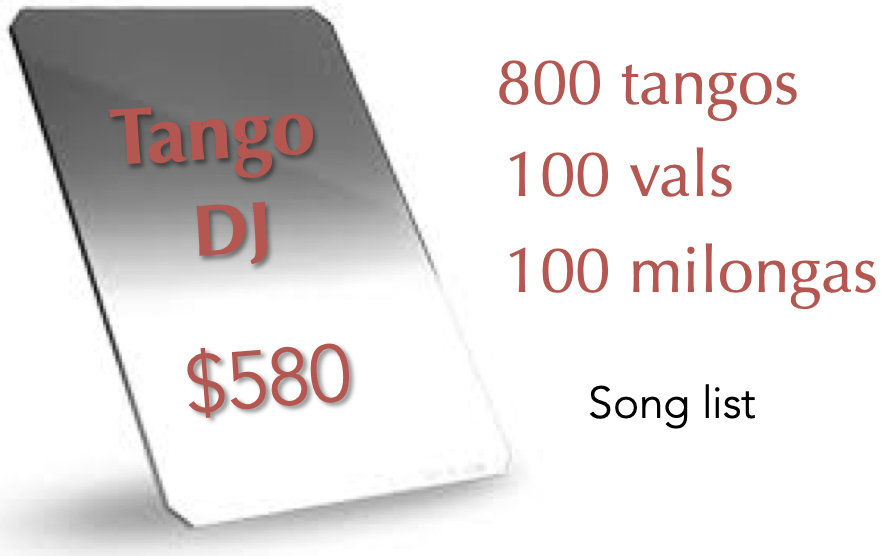
1,215 tangos; 185 milongas; 215 vals.

As you know, the sound quality of the Argentine tango catalogue is all over the map. You buy a CD and might find the first cut is not bad. But the next cut by the same orquesta might be scratchy and thin. There has never been any consistency in levels or quality.

I began addressing this issue in 2001, taking a different approach to restoration than anyone I've ever heard of. I repair the damaged wave-forms by hand. It is the only way to satisfactorily remove clicks and scratches and dust which were present on the original 78 rpm masters the record companies archived without taking away from the music itself. My way allows for the sound of the instruments to actually be enhanced because I've removed the problems which make that otherwise impossible.

Of course, this method is mind-bogglingly slow and tedious. But the results make it all worthwhile. The Golden Age musicians, arrangements and songs were brilliant and deserving of every effort to make them sound as good as possible so they can be enjoyed for all time. And I believe the perspective of being a sound engineer, music producer, tango dancer, teacher and dj gives the project added relevance. I know the music and what it's for.

In the first few years of this work, I developed the methodolgy, learned a lot of tricks and collected anything I could get my hands on.

In 2004 and 2005 I re-did everything I had done. And that's what I've done again.

In the interim, I've sourced better versions of most of the songs to work from. And there has been a quantum leap forward in the technology and tools available for the restoration artist. If you can find the time!

We all know that being a good tango dancer takes time and comes through continual love of the dance and lots of patience. Same thing with working on the music. If you're willing to go through the pain and suffering - tango richly rewards!

I've actually only just finished the engineering part, which took months of 7-day-a-week concentration; so re-vamping this website and adding new audio samples is still to come.

The ToTANGO Restoration Project has been from inception a sharing exercise. People who buy the music support me in the work - they get great music you can't find anywhere else in such quality. I pour everything back into the project. There's nothing like having a labour of love in life that you can share with people around the world! And make everyone's tango life richer.

The restored tango recordings are available in a variety of configurations and formats. Some casual dancers get a few CD's - some dj's get the whole catalogue.

I just like the fact that everyone who gets it plays it for other people and therefore the fabulous music of the geniuses of Argentine Tango gets a new hearing and appreciation from their ever-growing fan base.

Keith Elshaw


ToTANGO


On Our Judgements
And the Open Mind Helper

How well I remember how my mind has changed over the years about what I think of this or that orchestra. When tango is new to one, we bring our wants and desires to it as well as our preconceptions. So, we like this, but don't like that - but maybe only because we can't really hear it yet. We need more time for acclimatization, etc. I suggest.

If you're going to stick around tango, I promise you that over time your opinions about things will change. This has certainly been the case for me and every good dj I know. Surely a pro dj notices what people like and, when not sharing an opinion, objectively gives the music in question a new listen to see if an old opinion still holds for them TODAY. (It's been one of my tricks all my life to let my audience influence me. It's a great shortcut. I always take requests and file away the who-and-what in my memory).

It has happened quite a lot to me over the last couple of years as I spent my thousands of hours cleaning the old recordings. They started to sound so different than what I was used to hearing, I gained a new appreciation for a lot of classic tango that I wasn't much interested in years ago.

Of course, having more music to like enriches life, no?

So, every time you hear yourself telling someone you don't like something, I hope you'll make a mental note to revisit that opinion with an open mind one day. I especially wish this for the odd person who tells me they don't like Di Sarli, or don't like D'Arienzo, or don't like singers. If you love tango, I think that's not possible. Sorry! These quick judgements tend to (and should) haunt us in the future.

(See my piece on Caruso and the singers below).


Coaching For Dancers
Semi-Privates

The important information dancers need to get to the next level never seems to be imparted unless you go for a private class. If you find a teacher willing and able to communicate what it is you need to know to be a better social dancer.

Our 2-hour sessions with a small group gives the benefits of a semi-private class - with lots of information about the music and how to move to it as well as they key body adjustments the individual ought to make.


read more


ToTANGO


The Age Thing
Maturity Comes When?

"Tango has to be understood and that happens at least when you are 45 years old." - Lucio Demare (he composed "Malena" when he was 36).

Wow. What a revealing juxtaposition of words.

Pugliese composed "Recuerdo" when he was a fresh teenager. (And never had another one as good).

(If Demare actually said that ...) it's both true and not true. I agree with the theoretical proposition - but ...

Always depends on the person. (Old souls do exist and are born - meaning young people can dance tango).

But, one way or the other, it takes appreciation of life experience to "get" tango, for sure.


Looking at Poema
Neat contast in styles

'Came across this page - which shows a few dances to Canaro's Poema - by different couples.

Aside from the general interest, it ought to be inspiring to lovers of Nuevo who haven't yet found a way to dance social tango in a close way when there are many dancers on the floor. Some lovely dancing by professionals here.

(Disclosure: I didn't know I was being quoted. I saw this page when doing a "Poema" google).


ToTANGO


Milonga
A Gift From The Gods

Milonga WAS given to us by the gods to bless our souls with joy and happiness.

But, it seems to me, the essence of milonga is not immediately devined by the new lover of tango. Milonga is like tango itself; also like what an interesting woman may do to an ardent gentleman admirer: kind of retreat behind a veil while the pilgrim makes his journey to a sufficient level of understanding that the veil may be safely let down for admittance.

My personal intuition is that there is kind of a path a good many people follow in getting all the way to "getting" tango. We fall in love with the tango dance; we eventually discover the joys of vals; after that, the milonga is more accessible.

But, few there seem to be in the lands outside of Argentina who have a feel for milonga.

The reason for this could be that, being in 2/4, it has the feeling of being "fast." Dancers who start to enjoy it and sense the fun tend to "run." Many orchestras have recorded milonga at a tempo pushing the limit because that's what one does for shows.

So, many will use milonga to kind-of show-off. Even before they have the skills to do so. In North America, one sees many men just running and pushing and flailing around - not providing much enjoyment for the followers who have to run to keep up. Those men are having fun, which is good. But, the milonga veil is still up for them - or they would not be that way.

I can only speak of personal experience and that may not be worth much. But for whatever it's worth, I offer that milonga reveals its true nature when danced slowly.

Those who attend my milongas or dance milonga with me know that I favour the slow and moderate-tempo milongas first of all. Canaro (the Master); Donato (a Genius); and of course moving up the tempo scale to Di Sarli, D'Arienzo and Troilo (Genius Masters as well).

The veil has been lifted when one enjoys the SLOW milongas (if I may say).

Milonga danced well is very subtle. No wild movements. No running. I always teach that - though it is very exciting music - the dancer should be very calm and peaceful inside to dance it well. Purposefully put the excitement meter on low. Slow the beating heart. Then everything opens up.

When I met with and interviewed maestro Roberto Alvarez of Color Tango, I told him that to use his milongas when I dj, I slowed them down (without changing the pitch) 4 B.P.M. so that they are danceable. (He did not take offense).

You have to breathe when dancing milonga. You can't breathe properly if your are running.

I recognize that fast milongas bring a lot of joy to many, many dancers. I play them. But, I work my way up to them. Starting off a milonga tanda with a really fast milonga doesn't make sense to me, musically. Start with a slow one; go up in tempo; finish with a fast one. This is my way, at least.

If the reader is not a milonga fan at this time, please know that your tango will be much more satisfying to you when you have become a milonga dancer whom others enjoy dancing it with.

To be a really good tango dancer, it seems one must have a beautiful vals and a beautiful milonga in them as well. Then, you can dance tango.

All good tango dancers know this to be true.


On Behalf of the Singers
Before Gardel, There Was Caruso

Who new to tango hasn't sought ought instrumentals first so they didn't have to listen to the "annoying" singers? Of all the aspects of tango requiring acquired taste, the singers take the most getting used to - to a non-Latin, non older-person ear.

For the first 30 or 40 years of tango, there were no singers. They kind of had to fight their way in. The one who really kicked the door down, of course, was Carlos Gardel. His was tango's biggest "before-and-after" moment.


read more


ToTANGO


Conscious / Unconscious
Different Approaches to Tango

If you're thinking, your partner has to be thinking, too.

If you're lost in the music, the feelings, the moment, you're partner can be, too.

In such a state, tango takes over.

When you "direct" it yourself, it plays hide-and-seek with you.

It's all tango; but when your brain is "off," the pleasure and satisfaction increases in proportion to your surrender.

This is why my way of teaching is to make the body memory work; to make things as automatic as possible in order that spontaneous expression comes out effortlessly.

I like to show how to hold the body; how it should move with your partner. How it signals to keep everything together. All so that the mind can be sort-of shut-off. Seeking unconscious competence.

The less "thinking" the better.


Ladies Leading
Opinion

Man though I am, I shall dare to offer another way of thinking about it all.

There is a very good reason why many women decide to give leading a go: so they don't have to sit all night.

Typically, there are more good women dancers than men. Most of the women I have seen, in many cities, giving lead a serious try is so that (as single women) they don't get bored out of their minds every time they go out. I'm on their side. Stay at home - or lead a bit? Why not? These tend to be women who have been dancing a long time and are good dancers.

No one should feel threatened.

Of course, they find me a willing partner and a help if they are seeking that. The ladies who lead me are social friends and we are having fun for a few minutes. Real tango fun.

It's a growing trend. 'Gonna happen whether people like it or not. Together with this is the trend of more men wanting to follow. It can only help their dancing.


Tandas - So Cool

As a programmer and as a dancer, the Tanda custom in Argentine Tango seems to me to be such a cool invention.

What are it's origins? Sergio Vandekier explains from Mar Del Plata:

read more


nipperCD


ToTANGO RESTORATIONS
Paying Homage to Great Artists

The first email I received in 2008: "Hi Keith - I ordered 5 CDs for my husband's Christmas stocking and my goodness. they are FABULOUS! What a difference compared to our other CDs. We absolutely love what you've done and would like to order more with your 5 CD special for $69."

The last thing I did in 07 was add 60 new Canaro renderings to the ToTANGO RESTORATIONS catalog. Also great additions by D'Arienzo, Laurenz, Troilo, Di Sarli and Lomuto.


And on the subject of recent emails, this from a DJ:

"Hi Keith ­ Going through Troilo, I realized I had 2 versions of 'Orlando Goñi' from 1952. One from the recently released "Archivo TK", and one I got from you awhile back. I wanted to believe that the new release might magically be a bit better but whoa! Wait a minute ... sounds like the typical "goose the bottom end and they will like it" treatment from TK. So listening a few times more, I was easily convinced that yours is better, by far (to discerning ears). I think you had good source material, and you took special care not to mess up the tonality of the piano and bass. Ohhhhhh, the piano sounds delicious on your copy! The whole thing is bright, accurate, with the bass in its proper position and sounding like a musical instrument rather than a fog horn.

So, out goes the TK version, and me with a knowing smirk on my mug as I do it, thinking of you there with your ears laid back tuning that track up a few years ago!!"


read more


Have ToTANGO's Exclusive Restorations In Your Collection!


Tango Conversations
One Way of Looking At It

It's easy to put oneself in a category, noticing that many other dancers are not the same.

We could be new or experienced; like to dance close, or not; prefer nuevo or not, etc.

Here is a category I am in: I don't really enjoy dancing if there is no conversation. By that I mean - both people expressing themselves.


read more


Considering Cortinas
The Dj's Personality Revealed

I've not discussed Cortinas here much, not wanting to criticize others nor reveal what goes into my special bag of tricks. ;-) But, really, with so many new dj's plying the trade, some of the issues ought to be examined and some guiding principles tossed around - for many nights are being diminished by bad cortina choices from amateur dj's.


read more


Tanturi


The Destruction of RCA's Masters
And now - the Details

When RCA destroyed it's Masters of tango recordings 40 years ago, a major reason for our Restoration Project took place.


read more


ToTANGO


Tango Styles and Attitudes

Peter Bengtson's Tango Style table is humourous - and/but full of insight ... a kind of mirror in many respects. Do you see yourself in it?


read more


ToTANGO


The Tango Trance

Seek it, and it will elude you;
Talk about it in too much detail
and it will haunt you evily.
Live for it, and you will die many deaths.

Treasure it, but don't hold onto it.
Dance with love and freedom
and it will embrace you.
Be vulnerable, and feel it's power.

Dan Boccia
Anchorage, AK
tangotrance.com


© 1997-2009 Elshaw Communications Inc.
All rights reserved.


The Pillar
 
The Bandoneón
The Immigrant
Bandoneón Affair
 
ToTANGO Best of the Best
Introduction - Criteria
Juan D'Arienzo
Carlos Di Sarli
Francisco Canaro
Osvaldo Pugliese
Miguel Caló
Ricardo Tanturi
Pedro Laurenz
Osvaldo Fresedo
Angel D'Agostino
Aníbal Troilo
Rodolfo Biagi
Enrique Rodriguez
Lucio Demare
Alfredo De Angelis
Edgardo Donato
Francisco Lomuto
Orquesta Típica Victor
 
Astor Piazzolla
 
ToTango Restorations
About Restoration
ToTANGO CD's 
DJ Forum
Guest DJ's
Keith's DJ Musings
 
Book Reviews
Piazzolla - A Memoir
An Anxious Quest For Freedom - The Dinzels
 
Plus
Julian Plaza
Alberto Castillo
Hernán Obispo
Domingo Federico
Elvino Vardaro
3 Women
Assassination Tango
The Beat of Montréal
Tango Lessons
Miami Tango Fantasy
Tango-L
Buenos Aires Tips
More Tango Thoughts
 
Today's Argentina News
 
ToTANGO Links
 
Tango Shoes


  Click for Montreal, Quebec Forecast