Tango History
Birth and Beginnings
Tango Terms & Etymology
Great Tango Tragedies
Carlos Gardel
La Cumparsita
 
 
ToTANGO Dancers
 
 
On Dancing Tango
Floorcraft
Why Tango? - A Leader
Why Tango? - Followers
Tango Gender Equality
Keys to Tango
Women & Milonguero Style
The Milonga Experience
Tango Talk - Our Interviews
The Tango Junkies
Dancing In The Moment
Art of El Cabeceo
 
 
Dancers / Teachers
Escuela De Milongueros
Osvaldo Zotto & Lorena
Miguel Angel Zotto
Fernanda & Guillermo
Carlos Gavito
Diego & Carolina
Fabián Salas & Carolina
Pablo Veron & Noel Strazza
Chicho & Lucía
Gustavo & Giselle
"El Pulpo"
Juan Carlos Copes
Maria Nieves
Eduardo & Gloria Arquimbau
Fabián & Roxana
Noche de los Milongueros


    Search ToTANGO:


email Keith
 
 
    Click for Buenos Aires Forecast
ToTANGO.net


      Keith Elshaw's                 Tango Weblog                    Since 1997  

trance


RIP Osvaldo Zotto
Pedro 'Tete' Rusconi
    

It's an unbelievably sad time with the sudden passing of two wonderful, inspiring tango dancers in Buenos Aires.

I can't speak about one first as if there was some kind of importance ranking.

Understanding that, I worked with Osvaldo Zotto for a few years at the Miami Tango Fantasy, so I'm feeling his loss with shock and great sadness.

I aways loved watching him dance. He had a great influence on my dancing style. Osvaldo was an inspiration to me 10 years ago.

What I particularly admired about Osvaldo - and Loreena - over the past decade was the sure confidence to "do" less-and-less in performance. To reduce everything to style and grace and not rely on flash to impress. Osvaldo had something extra (which I believe he worked very hard to command) and that included sublime artistic vision.


Tete  


Tete found a place in my heart the first time I saw him dance.

And yes - he was an inspiration to male dancers and a joy to behold for female dancers.

Tete and Osvaldo both gone within 1 day of each other.

Both leaving a legacy of giants.


ToTANGO.net
Restorations


Version 4.0 Now Available

October 4 marked the release of the newly expanded ToTANGO Restoration series. Now 2,639 heavenly songs.

800 more than ever before.


For those who take great pleasure in life from listening/dancing to Argentine Tango, there is nothing like having a huge treasure trove of music arrive ... making it necessary to devote countless hours to listening to it all!

One continually comes across surprises and things that make the brain go "Ching" as another penny drops into the understanding pot, so to speak.

It's a kind of orgiastic flood of emotions telling you again and always why you love tango so much.


email


Stages
And re-inventing oneself

The more one learns of tango, the more one can grow.

As the ways to deal with the mysteries are negotiated, the inner smile feels OK to take on more assurance.

A regular re-invention of the self seems to be called for. Incorporate; internalize in that process; then stand on your shoulders and be open for the next break-through. Let things take natural-for-you time.


The teacher (of various things) in me has always thought one of the most insightful lines ever written was:

Rome wasn't built in a day.

All my tango teaching seems these days to be about showing leaders how to take the follower with them (while leaving spaces to be a follower himself so a conversation can be had) and followers what responsiveness is and how to take the moment for their own when appropriate.

Tango-tango is so richly rewarding, mysterious and comprising the wisdom of the ages that it surely is the only religion ;-) which doesn't ask a tithe nor threaten with damnation nor pretend to know everything no one can possibly ever know.

It just allows sublime commuinication with another in this moment.

Why the astonished-by-tango mayor of Paris once famously said: "In France, we do it lying down."


trance


"Thanks - I Needed That"
    Oh, those sweet little words

Any time those words are spoken, it's a good bet that both parties feel to say it to each other - even if only one says it. The whole it-takes-two thing.

I hope it happens at every level of proficiency in the dance; but I know assuredly that it happens most pleasingly at a certain level of advancement.

It's one of the most beautiful moments tango gives.

For it has come after two people who probably don't know each other or who haven't seen each other for some time finish a dance that engaged and enveloped and soothed them both. Unexpectedly. Totally. They lost time while they were lost in the embrace and the music. It gave them each what they most love about tango. Some crazy, creative, locked-in transportation to tango heaven. The surprise that satifies.

When those words are spoken, one can trust that there is fervor in them.

What spoils one about tango has just been experienced. It is to die for.


tango


Audio Interview with Ignacio Varchausky
Today's Pre-eminent Tango producer/leader

One of the people I personally admire most in the tango world of today is this gifted young bassist/producer.

Named Artist of the Decade by the city of Buenos Aires, Ignacio's ever-growing body of work has and is giving new life to tango-tango culture.

Founder of El Arranque and Escuela De Tango, producer of those and Nestor Marconi, Horacio Salgan, Vale Tango among others, Ignacio has been making the best modern recordings of tango music.

Ignacio Varchausky is also the founder of TangoVia Buenos Aires, a non profit organization, which aims to preserve, spread and develop tango culture throughout the world. He has launched the Tango Digital Archive Project to save the 100,000 tango recordings extant before they are lost or destroyed.


I booked a Skype session with Ignacio on October 27, 2009 to ask him to speak about all these projects and to ask him how tango lovers around the world can help with the archival project. Here it is in 3 parts.

Part 1
El Arranque; Emilio Balcarce and Pugliese; La Yumba; the research hows; the sheet orchestrations

Part 2
The gems; Ignacio Corsini; rare test-pressings and movie soundtracks; Troilo singing; rare Salgan solo recordings; Alfredo Gobbi acetates; newly discovered great compositions; sources and restoring; whole discographies

Part 3
How to help; tax-deductible donations; how Ignacio views the world tango community


http://tangovia.org


email


Very Cool Treats
Audio tours of interesting things

In simply putting on the music of the restoration collection and letting it run, so many sublime moments fill the air.

We're going to do a few little audio programs flying through some of those moments.

First up: Julio De Caro Orquestas

(Sounds starts with page load)


email


Mailbag
Comments on ToTANGO Restorations 4.0


read more


tango


Trends And Things
We're all in the same boat

I'm in touch with promoters, teachers, dj's and dancers around the world. We talk.

And I find it really interesting how local situations tend to be quite similar no matter where you are. This is comforting when in your own community you despair about a development - only to find that your pals in other places are seeing the same things happen. Helps one to relax a bit

We've all been dealing with the issue of churning; old fav partners not coming out anymore because new people aren't being taught to be respectful of the ronda and other people's spaces, etc. If there's no one you want to dance with, you start staying home, too. I would like to think that time is slowly erasing that problem and people are learning. Then the problem becomes: how to get the stay-at-homes back out after they've decided they are interested anymore?

The current issue most everywhere is also a result of the tremendous growth in popularity of tango: too many places happening - so all the usual places have less people. Blessing and curse all at once.

The fact is: people go where there are people. No people - no fun. So numbers make the night happen.

In the "good old days" before 2004, organizers used to work together. They didn't have to like each other, but things just worked best when communicating in advance about plans and doing things so that conflicts in scheduling were avoided.

This was a tradition which got lost when a a free-for-all attitude came along during the Moron Bush years. Lots of new people fell in love with tango and decided they should have their own milonga or be a teacher. Everybody became a cowboy in that sense. I'll do whatever I want, **** you! Ouch.

OK. We're free to do what we want. Can't argue.

So, new places spring up. Competition on every night. Just too much going on. Everybody's numbers down. Less fun. (No fun to endure). The curious circumstance that the community is actually growing - but not so's you can see anywhere just any time.

Endure is the word. Time has to go by and things shake out naturally. And in that way, progress is made. The strong will survive and all of that. But hopefully without killing each other!


Podesta


Beatriz Dujovne's
Tango: a Way of Being

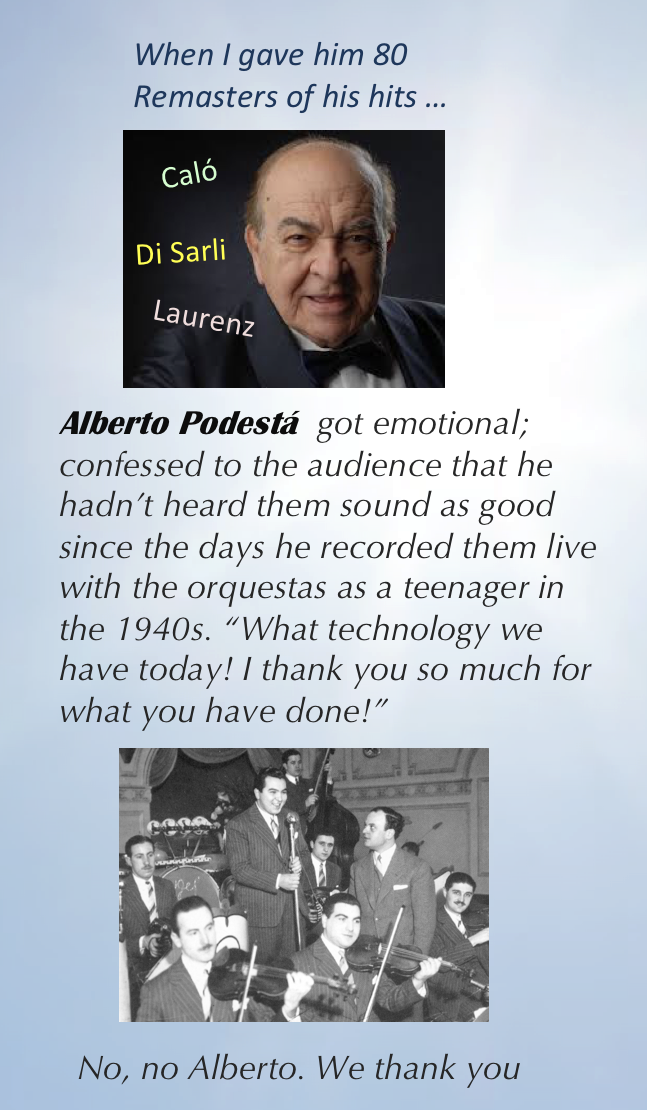
Beatriz's recent word portrait of still-going-strong Alberto Podestá.


ToTANGO


If near to Montréal ...

My semi-private classes are about to resume after summer break.

I call them semi-private because I keep the group small - while giving the kind of attention and information one gets in a private class. For a lot less money, of course.

I show how to be and how to move and when (with the music) - as opposed to how to "do things."

I also say, I'm not calling myself a "teacher" and giving you a "class." I think of it as coaching - addressing personal needs. In as close-to a milonga situation as can be, given the purpose. It's more of an indoctrination into the tango world than a standard, "Learn these steps" class.

A new client asked me to put this on my webpage:

"Too many bad teachers out there. Without teaching me or telling me, you prepared me for the lesson. I learnt it on my own. Which is why you are the best teacher anyone can have. Except of course you're not a teacher. You are Tango Tango!"

Thanks Keith,

Robert Rudman


read more


tango


Love Is  ...  What We DO
(Not about tango, but -
What about tango doesn't call for love)?


Love
Is a command to rise to one's highest potential
The best and noblest vision of ourselves

Love is a reward; the greatest we can earn
Granted to us for
The moral qualities we have achieved in our lives.


These lines, delivered by the wonderful actor Helen Mirren, close a nice little film I recently saw which was made in Toronto in 1999.


ToTANGO


Montreal - Birthplace Of The Record

You can imagine that I love to tell this story ...


(And I hope you'll look at the Les Paul piece further down).


ToTANGO


"New" Treasures From The ToTANGO Restoration Vault
Firpo and Filiberto Sounds To Make You Swoon

I love this picture of the Roberto Firpo Orquesta in the recording studio. And I LOVE the music they made.

It's a mystery to me why Firpo's Orquesta recordings aren't easy to come by, as much as it is a mystery to me why he isn't thought of as one of the very best orquesta leaders there ever was. Fortunately, his legacy as a composer is well-known for his huge hits like Didi, Argañaraz, Sentimiento criollo, De pura cepa, Marejada, Alma de bohemio, Fuegos artificiale, El amanecer, El rápido, El apronte - it's a looonngg list.

The orquesta recordings are so completely different from the well-known Firpo quartet recordings that, when first hearing them, it's hard to believe it IS Firpo. I'd like to play you some clips of my renderings of his sound from the 1930's (I have lots from the 20's as well).

I find his orchestrations delicious and sexy (his rhythm is very rolling-funky). And when there is a vocalist (sometimes a chorus of singers), the sound is beautiful. As in all the great tango orquestas, the musicians are phenomenal - but Firpo shows off their talent in an even more outstanding way.

Roberto is, of course, the pianist. But the charts are his so every note is what he decided.

Here is the ending of "El Compinche."

(Hit the "back" button after the file plays).

One of the big things which jumps out is Firpo's voicings of the strings. The harmonic blend is something else (and they were beautifully recorded). Here is a bit of his glorious "Didi."

And finally, one of my all-time favourite recordings, the sublime "Homero.". He's got clarinets, a muted trumpet, incredibly sweet bandoneons and the tango-tango beat at it's best. All his songs are filled with the most incredibly delicate fast runs by all the instruments.

Why isn't the Firpo Orquesta played every night in every milonga in the world? (This is Keith on a trip again as I've done in the past with Biagi and especially Donato). ;-)


ToTANGO


JUAN de DIOS FILIBERTO


His short list of hits composed: Quejas de bandoneón, Caminito, El pañuelito, Malevaje, Clavel del aire, Cuando llora la milonga, Malevaje, Mentías and Yo te bendigo. Wow.


Staying with the rich orquesta theme - but now getting into a bigger orchestral sound (2 and 3 times as many musicians), we come to the unique sound of Filiberto.

This music is rich, subtle and refined ... and therefore must be introduced in a milonga with care and attention. It's not for everybody or all the time. Being pretty mellow, I tend to keep it for late-night; or certainly when I want a BIG change in the atmosphere.

As an orchestra leader, Filiberto was working on an entirely different concept than all the other guys. You can dance to it, but it has a concert orientation. In fact, Filiberto ran a large unit sponsored by the City of Buenos Aires. He wasn't making his living by doing dances with small combos.

His music is rich, rather sedate, operatic, but certainly sexy in it's own way. Certainly has a special place in the tango music pantheon.


Here is a song I have been playing at certain moments for 20 years in a milonga, La Maleva. It has a special feeling. But, I admit that I felt he went through the theme too many times, so - with dancers in mind - I cut a minute out of it. My version is 3:23 in length. That's plenty. (I'm making dances, not concerts).

People who know me know I am absolutely crazy for milonga. I like 'em "slow" (just as I like my vals fast). So my big favs are Canaro and Donato. But here is a gem you will likely almost never hear except why you have me dj-ing. I only put it on in a rare moment - but it always blows people's minds. Again - to me it's for late-night when the energy is winding down.

Here is the ending, with the surprise vocals, of Porteñita.


Well, at the very least you could say that adding this kind of music to your library gives you more places to go when you're looking for that special something extra to add to your bag of tricks!


-----

Deep Thought: I feel like what I'm doing is making the old recordings sound like, instead of just the one microphone recording the band, I've been able to add a few more mics and get more of the instruments.

-----

SOME BEFORE-AND-AFTER SAMPLES from ToTANGO RESTORATIONS 3.1:

Let's listen to a portion of Siete Palabras by Maestro Carlo Di Sarli, recorded August 29, 1945.

This is what it sounds like on a commercial CD I purchased.

This is what it sounded like after I cleaned it but before Mastering. (Source was from a transfer of the 78 on an lp (33 1/3) released in 1968. Still scratchy, but nicer underneath the noise than what the CD offered. I'm a big analog fan (notice the strings are sweeter sounding? - even though I work in the digital realm). (Thanks to my beloved ex-sister-in-law Maria Nieves for giving me her record collection)!

This is what it sounds like after Mastering my cleaned rendering. (Of course, the better the speakers you listen on, the more difference you will hear).

Always ringing in my ears are the comments I've heard from new people to tango who say, "Why do you like that old music?"

My answer is to make it sound more like it was recorded yesterday so they can hear how great it is. I'm seeking to add dimension, clarity and warmth - so it's like the orchestra is in the room with you. Or we are there with them when they recorded.


-------

Osvaldo Pugliese's El Arranque (1944) commercial CD version.

Let's say I wanted to clean that by running it through my sophisticated computer software. This is what it would sound like (notice there is still noise, even though I've got it cranked. And the music doesn't sound like music any more (what I call the garden-hose effect). And the level is really low even though I've cranked that up, too. Please turn your monitors back down before you play the next file).

Now here is the ToTANGO cleaned and re-mastered version. (You wouldn't believe how long I sweated over the first 10 seconds. Took forever and drove me crazy - but makes me smile every time I hear it now. To a tango dancer, that's a god there playing the piano; and to me one also in the first bandoneon chair).


------

For me, it isn't just about taking noise away - it's every bit as much about making the sound round and more listenable; so that when you turn it up, it doesn't give you a headache.

Anibal Troilo's Yo Soy El Tango commercial CD version(March, 1941).

The new ToTANGO version.


The above examples show what I am doing with the entire tango catalogue. Clean, warm; musicans and singers present and clear like they are in the room with you.

Enough with the "I love the old scratchy records" dissembling. Let's hear them as good as they were without clumbsy decades-old technology faults in the way. Por favor.

(I guarantee you the bands didn't bring scratchy record sounds to introduce into their live performances so it sounded "like their records" when they played live).

My mission is to put a smile on the musicians' faces when they hear their old records on the great juke-box in the sky. If I can.

Not to mention putting a smile on dancers' faces (like my own) around here today!

;-)


ToTANGO


Les Paul  R.I.P.

For the last 35 years - ever since I began producing records - I would take every opportunity I could get to go on and on (as I do about tango musicians) to anyone I could assault with stories about a great hero, Mr. Les Paul (nee Lester William Polfus).

I tell people he invented modern music; in that modern music we hear through media is made in the studio. Most of the crucial techniques we use were invented by him.

He was 14 years old in 1929 when he gave birth to the electric guitar.

After, he invented techniques for delay (echo), over-dubbing and multi-track recording.

The modern world of music, folks: Les Paul. Then, everyone else.

The night he passed, all my cortinas were edits of his recordings. I admit I didn't have the nerve before. How silly. They worked great. And I went 'round "assaulting" all our patrons with the stories! It actually made for a great night. A celebration of a wonderful life was in order.

This great song was a total miracle when he put his version out. 2 people sounding like a heavenly chorus. (He recorded everything in his house. Not WHY I do that, but he still is an insipiration). It changed the world. I loved this man from afar for all that he gave us.

You Rocked, Les! Way before anybody but you knew what that meant!

Les was playing guitar in big bands in the 40's when he met Colleen Summers. He married her, changed her name professionally to Mary Ford, and brought his inventions and creations out packaged around "Les Paul & Mary Ford" to change life as it was known.

Look at how cool they are in this TV show from around 1952. Don't you just love them? The look in her eye, the look in his eye when he starts his solo ... wow. This is what genuine people used to be like when the media came around (before the media slaves went back to being neanderthals).

This TV moment is just so rich. Wearing the headphones because that's how musicians actually work in the studio even today, of course. The tape machine view must have been one of the first seen on TV. And the tape is running at 30 ips - how it was actually done in the beginning. Authentic all the way. Les starts the playback himself! This is the most perfect representation of production which is "real" in many ways; an actual LIVE tv production purporting to show how real-life works ... but untarnished by phoney techniques we're all accustomed to that make "live" and "real" so stupid and unreal.

Her performance attitude almost takes my breath away. So relaxed and natural. Man, would I have loved to have danced a tango/vals/milonga with her.

Both of them are so smooth in making it look like they are actually performing what we are seeing/listening to. (This alone makes them exceptional no matter what year it is).

When making the records, Les put a few mics around the house. He'd be out in the garage putting his guitar tracks down (bass, rhythm, leads, doubling them all, etc.) and when he was ready for her, he'd yell, OK, baby! She'd take a pause from whatever she was doing - there was a mic over the kitchen sink, for instance - and give him another vocal take. I'm sorry, these two were something else!

(I love Les's little inside joke in the introduction - it's so refreshing to see intelligent people making media. Alistair Cooke says "26 parts" in his British accent, which sounds like "pots." Les says, 26 "pots" with a smile, because in the studio, potentiometers, which control levels, are referred to as "pots" of course!)

Anyone around the world who went into a store in the 50's to buy a "hi-fi" record player would most likely have been given a demonstration of how good it was when the salesman played a Les Paul record. Les set the standard of excellence in audio fidelity. Period. With sounds no one had ever heard before. Les Paul was George Martin/Sargeant Pepper and more in 1950 - changing people's perceptions through unique auditory stimulous. And there couldn't have been an Elvis or Beatles or Beach Boys or Led Zeppelin or Queen (Freddie Mercury singing 5-part harmony tripled (15 tracks of just him) or any other recording act without his inventions.

I don't mean to get technical, but - how could there have been rock 'n roll culture without the electric guitar, delays (all over Les's records for the first time) and multi-track recording? Basically, every record made since 1950 used tools he invented. Les Paul facilitated the creation of the soundtrack of our lives.

And if there had been no rock 'n roll culture, no modern recording technology from Les's brain, we wouldn't be living in the world we know now, for sure.

"Somewhere, there's MUSIC!" How high the Les Paul Moon. Which he brought "down to earth." Thank you, kind sir.

-------

OK - this is Keith being a "bad boy" ....

It was driving me crazy that I couldn't play Les and Mary in a milonga. So (thinking Les wouldn't really kill me because he wanted people to have fun), I've slowed it down to a dancable speed for tangueros. And enhanced the sound a bit. I am sure he would say, "go for it!" It is only with the greatest respect I venture to do so.

This might be a rude shock if you listen immediately after listening to his original - but if I carefully spring it on you late-night on the dance floor ...

Keith's danceable version of Les and Mary's "How High The Moon"


ToTANGO


"It Takes Two" (Another Take)
Tango & Jazz

Music means SO much to a person alive. It certainly has to me. In so many ways, so many forms, always.

To say that my life changed drastically and forever when I discovered Argentine Tango is mild understatement. At one and the same time, it gave me a new life while simply allowing me to get in touch with who I am and had always been. On multiple levels.

How much the "discovery" of the New World changed life on the planet. I've always enjoyed moments of contemplation of the 2 Sublime forms of music that the New World then created and gave back; and they both came about in the same way and at the same time: Tango and Jazz.

Two great cities at the mouth of 2 great rivers which drained much of both continents. Port cities inhabited by immigrants from all over and constantly visited by ships carrying more. In touch because of the sea - how the world worked then. Facilitating growth and sustenance. Blending; seething; incubating, developing. Brazen, profane, creative, profound. Finding a way to make life's sorrows feed life's possibilities and the hungry human spirit everywhere.

And in those two great cities, unlike any other, music and culture was born which changed the world.

New Orleans. Buenos Aires.


Do you remember the first book you ever read that made you fall in love with words, stories, information - the outside world - that gave you a thirst for more?

I was 10 years old growing up in a rural Canadian farming/vacation community (a town of 10,000 people) when all this happened to me. The first book for me was a biography of a Saint - Louis Armstrong. How blessed I have always felt that my first hero was that genius. It's like my whole life of passion for music of all kinds that is Good was given to me in a context I could judge it by because knowing about "Pops" taught me everything I needed to "know" intuitively, right off-the-bat.

Being so young, it would be years before I knew of Mozart, Bach (the first great improvisationalists) or Beethoven nor certainly Gerardo Matos Rodriguez or Fancisco Canaro; but I had a true compass inside from that early age. More than I knew, of course.

And of course - even though I was studying piano soon thereafter, it was the trumpet that I really wanted to play (so in awe of Satchmo). I started on cornet in a marching band with uniforms and all that playing John Phillip Sousa (how stirring); then Herb Alpert (!) and the school orchestra standard repetoire from Broadway and Europe. Then, my love of radio took over and I became more a producer/ story-teller than a musician.

Tango didn't enter my life until I was 40. But the moment it did and I began to study it, it captivated immediately because it was touching something in me so powerful I was lost in it before I knew. Then grew to recognize that tango took me to the soul of music as my love for Louis had once done.

The parallels in the development and then influence of Tango and Jazz are so striking. Both anticipated and became the music of the modern world of Relativity and Quantum Mechanics (another great duo). Both were like nuclear bombs in culture. As were the other 2!

Always I want to go on and on about the parallels, the open, ensemble perfection, the essence of what these two contributions to life from the New World mean, portend, deliver. But, that would take a book.

But, it's about joy. Dialogue. Working out all the complications of the inner self in a negotiation with others human beings.

If you're ever in a milonga where I'm doing the music and you've found that late at night I have lead-up to playing "It Takes Two To Tango" or, "Kiss Of Fire" (an English version of El Choclo) or "La Vie En Rose" by Louis Armstrong, I hope you will laugh and dance for joy because you sense the connection between the Saints and the "sinners" (us) - who know how to be passionate in life in the way only Tango can allow.

For we share a secret, don't we? Tango is even deeper and more intricate than jazz. Jazz lost it's way as a provider of a connection between 2 moving bodies in harmony as WWII was ending. This, of course, is why Piazzolla was a pariah in Argentina to dancers. Same thing.

By the mid-70's, both had kind of "died." (Ha!) The greats went to their graves one-by-one, too fast. The times had changed.

But, the great rivers formed varied tributaries. And were born again.

If you like the ways of the old tango and the old jazz, it's all there forever. And to a heart seeking the essence of communication, both will always be young and keep us young.

An open mind (an open ear, an open heart) is a beautiful thing. As is courage.

And respect for the people whose shoulders we stand (or dance!) on.


-----

(To get a beautiful picture/understanding of how Louis Armstrong changed the world, I highly recommend the 2001 PBS documentary by Ken Burns, JAZZ).


ToTANGO


Dance For The Children Charity
A Way of Giving Back To Argentina

John and Cheryl Lowry and friends in Brisbane, Australia began this charity work 9 years ago. They raise money in the tango world to make life better for homeless children in Buenos Aires.

To me, it's such a great idea: have a milonga once a year in your city donating the proceeds to this cause and give something back to Argentina's future.

Their website.

I asked Cheryl and John to visit with me on Skype and tell the story of what they do and where it's all going. I hope you can take 12 minutes to listen to ToTANGO Podcast #1.

(You are invited to get in touch if you have an idea for one. It's a way of making the tango world a little smaller and a little bigger all at the same time).


ToTANGO
 

The Tango Music Universe
How Things Have Changed

Tango was just coming out of a long, cold and dark night when it captured me in 1989. For 40 years, not much had been happening.

This period of almost hibernation was brought on by the political and economic situation in Argentina which followed WWII. The once fabulously rich nation was brought to its knees by a military junta doing about everything possible the wrong way. The protectionism and disdain for international trading relationships had really taken traction through the '20's and '30's; the Generals then screwed the lid tight after that war.

Of course, Juan and Eva Peron had, during their dictatorship, affected a tango style. Juan copied the Gardel look. Eva the show-girl loved the night-life. When they were overthrown, the Generals stomped on the tango culture with a fierceness equal to their hatred of the Perons. You're not going to have a thriving tango culture when nightly curfews extend for decades.

So, we had Tango For Export as the face of tango around the world. And the Piazzolla phenomenon. And an Argentina pretty much in misery; beat down by its own.

And then, history repeated itself: the world outside of Argentina fell in love with tango again.

I didn't know it at the time, but I was part of the renaissance that happened after Tango Argentino toured the world. For when I started, there were enough people around interested in classes and shows that a scene was about to become established throughout the world.

My interests from the first were to learn how to dance and to collect the music. Both were to take a long time before I could feel satisfied with what I had - for times were really different then before the web shrunk the world.

In the dancing part, there were no milongas where I lived until we started our own after 5 years of only dancing in weekly classes. Pretty hard to get good that way. And of course, all the teachers I encountered taught Tango Por Export.

There were a few CD's around, but not much danceable music on them. And the quality was pretty terrible. After discovering that the Columbians had always loved tango music, I frequented Latin-American book stores where I could find Columbian-manufactured lp's and cassettes of Argentine tango music.

I was obssessed with collecting and learning about this wondrous, heavenly music that had been recorded before I was born. I wanted to know "everything" about it and have it all in my hands.

I married my first tango teacher, and through her was able to beg her Argentino compatriots living near me to let me copy their cassettes. That was the only way to find what wasn't available in stores.

Juan Carlos Copes actually gave me my first great tango music collection. He gave me 2 90 minute cassettes he used for teaching. It was unbelievably great music I had never heard before! There was, however a big problem with it (aside from being cassette copies of bad pressings): there was no list of titles or artists. I remember assuming that many of the orchestras were D'Arienzo! (Well, I knew his name now - and Canaro and Di Sarli. How excited I was the day I found out about Miguel Calo and could then identify his music).

So that's how I began. Not a clue. No internet research tools. Just Argentine friends and family to pester with questions. Thank god for them and their generous indulgence!

But what joy I felt when I could find a cassette or two or an lp or CD I didn't have. From day one I had a purpose, because I would compile the music my wife would use in her classes and eventually our milonga. With my radio programming background, I essentially became a tango dj day from the day I began to learn how to dance.

What a contrast between those years and how things are now. I often think how lucky the people are who get me to ship them my restoration library. One day they open the mail and have 1700 beautiful tangos made for dancing fall into their lap. I would have died to have found a source like that 20 years ago. But then - I wouldn't have had the fabulous journey of discovery from being lost to being found ...

Lately, my interest is in uncovering great recordings from the 1920's - well, as far back as there are records. The music from this era is glorious beyond description.


ToTANGO


ToTANGO 3.0
What is it?

Just released, a complete re-mastering of the ToTANGO Restoration library of great Argentine Tango from the 20's to the 50's. All chosen for being great to dance to.

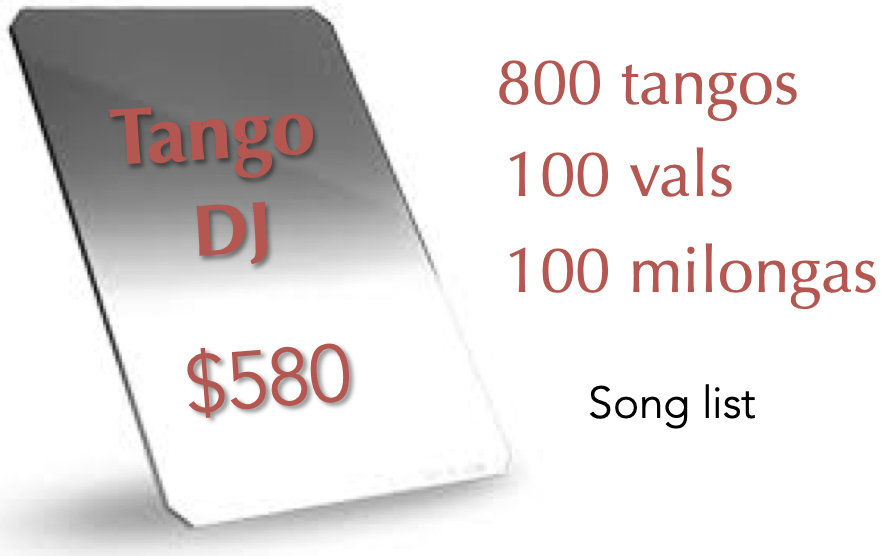
1,215 tangos; 185 milongas; 215 vals.

As you know, the sound quality of the Argentine tango catalogue is all over the map. You buy a CD and might find the first cut is not bad. But the next cut by the same orquesta might be scratchy and thin. There has never been any consistency in levels or quality.

I began addressing this issue in 2001, taking a different approach to restoration than anyone I've ever heard of. I repair the damaged wave-forms by hand. It is the only way to satisfactorily remove clicks and scratches and dust which were present on the original 78 rpm masters the record companies archived without taking away from the music itself. My way allows for the sound of the instruments to actually be enhanced because I've removed the problems which make that otherwise impossible.

Of course, this method is mind-bogglingly slow and tedious. But the results make it all worthwhile. The Golden Age musicians, arrangements and songs were brilliant and deserving of every effort to make them sound as good as possible so they can be enjoyed for all time. And I believe the perspective of being a sound engineer, music producer, tango dancer, teacher and dj gives the project added relevance. I know the music and what it's for.

In the first few years of this work, I developed the methodolgy, learned a lot of tricks and collected anything I could get my hands on.

In 2004 and 2005 I re-did everything I had done. And that's what I've done again.

In the interim, I've sourced better versions of most of the songs to work from. And there has been a quantum leap forward in the technology and tools available for the restoration artist. If you can find the time!

We all know that being a good tango dancer takes time and comes through continual love of the dance and lots of patience. Same thing with working on the music. If you're willing to go through the pain and suffering - tango richly rewards!

I've actually only just finished the engineering part, which took months of 7-day-a-week concentration; so re-vamping this website and adding new audio samples is still to come.

The ToTANGO Restoration Project has been from inception a sharing exercise. People who buy the music support me in the work - they get great music you can't find anywhere else in such quality. I pour everything back into the project. There's nothing like having a labour of love in life that you can share with people around the world! And make everyone's tango life richer.

The restored tango recordings are available in a variety of configurations and formats. Some casual dancers get a few CD's - some dj's get the whole catalogue.

I just like the fact that everyone who gets it plays it for other people and therefore the fabulous music of the geniuses of Argentine Tango gets a new hearing and appreciation from their ever-growing fan base.

Keith Elshaw


ToTANGO


On Our Judgements
And the Open Mind Helper

How well I remember how my mind has changed over the years about what I think of this or that orchestra. When tango is new to one, we bring our wants and desires to it as well as our preconceptions. So, we like this, but don't like that - but maybe only because we can't really hear it yet. We need more time for acclimatization, etc. I suggest.

If you're going to stick around tango, I promise you that over time your opinions about things will change. This has certainly been the case for me and every good dj I know. Surely a pro dj notices what people like and, when not sharing an opinion, objectively gives the music in question a new listen to see if an old opinion still holds for them TODAY. (It's been one of my tricks all my life to let my audience influence me. It's a great shortcut. I always take requests and file away the who-and-what in my memory).

It has happened quite a lot to me over the last couple of years as I spent my thousands of hours cleaning the old recordings. They started to sound so different than what I was used to hearing, I gained a new appreciation for a lot of classic tango that I wasn't much interested in years ago.

Of course, having more music to like enriches life, no?

So, every time you hear yourself telling someone you don't like something, I hope you'll make a mental note to revisit that opinion with an open mind one day. I especially wish this for the odd person who tells me they don't like Di Sarli, or don't like D'Arienzo, or don't like singers. If you love tango, I think that's not possible. Sorry! These quick judgements tend to (and should) haunt us in the future.

(See my piece on Caruso and the singers below).


Coaching For Dancers
Semi-Privates

The important information dancers need to get to the next level never seems to be imparted unless you go for a private class. If you find a teacher willing and able to communicate what it is you need to know to be a better social dancer.

Our 2-hour sessions with a small group gives the benefits of a semi-private class - with lots of information about the music and how to move to it as well as they key body adjustments the individual ought to make.


read more


ToTANGO


The Age Thing
Maturity Comes When?

"Tango has to be understood and that happens at least when you are 45 years old." - Lucio Demare (he composed "Malena" when he was 36).

Wow. What a revealing juxtaposition of words.

Pugliese composed "Recuerdo" when he was a fresh teenager. (And never had another one as good).

(If Demare actually said that ...) it's both true and not true. I agree with the theoretical proposition - but ...

Always depends on the person. (Old souls do exist and are born - meaning young people can dance tango).

But, one way or the other, it takes appreciation of life experience to "get" tango, for sure.


Looking at Poema
Neat contast in styles

'Came across this page - which shows a few dances to Canaro's Poema - by different couples.

Aside from the general interest, it ought to be inspiring to lovers of Nuevo who haven't yet found a way to dance social tango in a close way when there are many dancers on the floor. Some lovely dancing by professionals here.

(Disclosure: I didn't know I was being quoted. I saw this page when doing a "Poema" google).


ToTANGO


Milonga
A Gift From The Gods

Milonga WAS given to us by the gods to bless our souls with joy and happiness.

But, it seems to me, the essence of milonga is not immediately devined by the new lover of tango. Milonga is like tango itself; also like what an interesting woman may do to an ardent gentleman admirer: kind of retreat behind a veil while the pilgrim makes his journey to a sufficient level of understanding that the veil may be safely let down for admittance.

My personal intuition is that there is kind of a path a good many people follow in getting all the way to "getting" tango. We fall in love with the tango dance; we eventually discover the joys of vals; after that, the milonga is more accessible.

But, few there seem to be in the lands outside of Argentina who have a feel for milonga.

The reason for this could be that, being in 2/4, it has the feeling of being "fast." Dancers who start to enjoy it and sense the fun tend to "run." Many orchestras have recorded milonga at a tempo pushing the limit because that's what one does for shows.

So, many will use milonga to kind-of show-off. Even before they have the skills to do so. In North America, one sees many men just running and pushing and flailing around - not providing much enjoyment for the followers who have to run to keep up. Those men are having fun, which is good. But, the milonga veil is still up for them - or they would not be that way.

I can only speak of personal experience and that may not be worth much. But for whatever it's worth, I offer that milonga reveals its true nature when danced slowly.

Those who attend my milongas or dance milonga with me know that I favour the slow and moderate-tempo milongas first of all. Canaro (the Master); Donato (a Genius); and of course moving up the tempo scale to Di Sarli, D'Arienzo and Troilo (Genius Masters as well).

The veil has been lifted when one enjoys the SLOW milongas (if I may say).

Milonga danced well is very subtle. No wild movements. No running. I always teach that - though it is very exciting music - the dancer should be very calm and peaceful inside to dance it well. Purposefully put the excitement meter on low. Slow the beating heart. Then everything opens up.

When I met with and interviewed maestro Roberto Alvarez of Color Tango, I told him that to use his milongas when I dj, I slowed them down (without changing the pitch) 4 B.P.M. so that they are danceable. (He did not take offense).

You have to breathe when dancing milonga. You can't breathe properly if your are running.

I recognize that fast milongas bring a lot of joy to many, many dancers. I play them. But, I work my way up to them. Starting off a milonga tanda with a really fast milonga doesn't make sense to me, musically. Start with a slow one; go up in tempo; finish with a fast one. This is my way, at least.

If the reader is not a milonga fan at this time, please know that your tango will be much more satisfying to you when you have become a milonga dancer whom others enjoy dancing it with.

To be a really good tango dancer, it seems one must have a beautiful vals and a beautiful milonga in them as well. Then, you can dance tango.

All good tango dancers know this to be true.


On Behalf of the Singers
Before Gardel, There Was Caruso

Who new to tango hasn't sought ought instrumentals first so they didn't have to listen to the "annoying" singers? Of all the aspects of tango requiring acquired taste, the singers take the most getting used to - to a non-Latin, non older-person ear.

For the first 30 or 40 years of tango, there were no singers. They kind of had to fight their way in. The one who really kicked the door down, of course, was Carlos Gardel. His was tango's biggest "before-and-after" moment.


read more


ToTANGO


Conscious / Unconscious
Different Approaches to Tango

If you're thinking, your partner has to be thinking, too.

If you're lost in the music, the feelings, the moment, you're partner can be, too.

In such a state, tango takes over.

When you "direct" it yourself, it plays hide-and-seek with you.

It's all tango; but when your brain is "off," the pleasure and satisfaction increases in proportion to your surrender.

This is why my way of teaching is to make the body memory work; to make things as automatic as possible in order that spontaneous expression comes out effortlessly.

I like to show how to hold the body; how it should move with your partner. How it signals to keep everything together. All so that the mind can be sort-of shut-off. Seeking unconscious competence.

The less "thinking" the better.


Ladies Leading
Opinion

Man though I am, I shall dare to offer another way of thinking about it all.

There is a very good reason why many women decide to give leading a go: so they don't have to sit all night.

Typically, there are more good women dancers than men. Most of the women I have seen, in many cities, giving lead a serious try is so that (as single women) they don't get bored out of their minds every time they go out. I'm on their side. Stay at home - or lead a bit? Why not? These tend to be women who have been dancing a long time and are good dancers.

No one should feel threatened.

Of course, they find me a willing partner and a help if they are seeking that. The ladies who lead me are social friends and we are having fun for a few minutes. Real tango fun.

It's a growing trend. 'Gonna happen whether people like it or not. Together with this is the trend of more men wanting to follow. It can only help their dancing.


Tandas - So Cool

As a programmer and as a dancer, the Tanda custom in Argentine Tango seems to me to be such a cool invention.

What are it's origins? Sergio Vandekier explains from Mar Del Plata:

read more


nipperCD


ToTANGO RESTORATIONS
Paying Homage to Great Artists

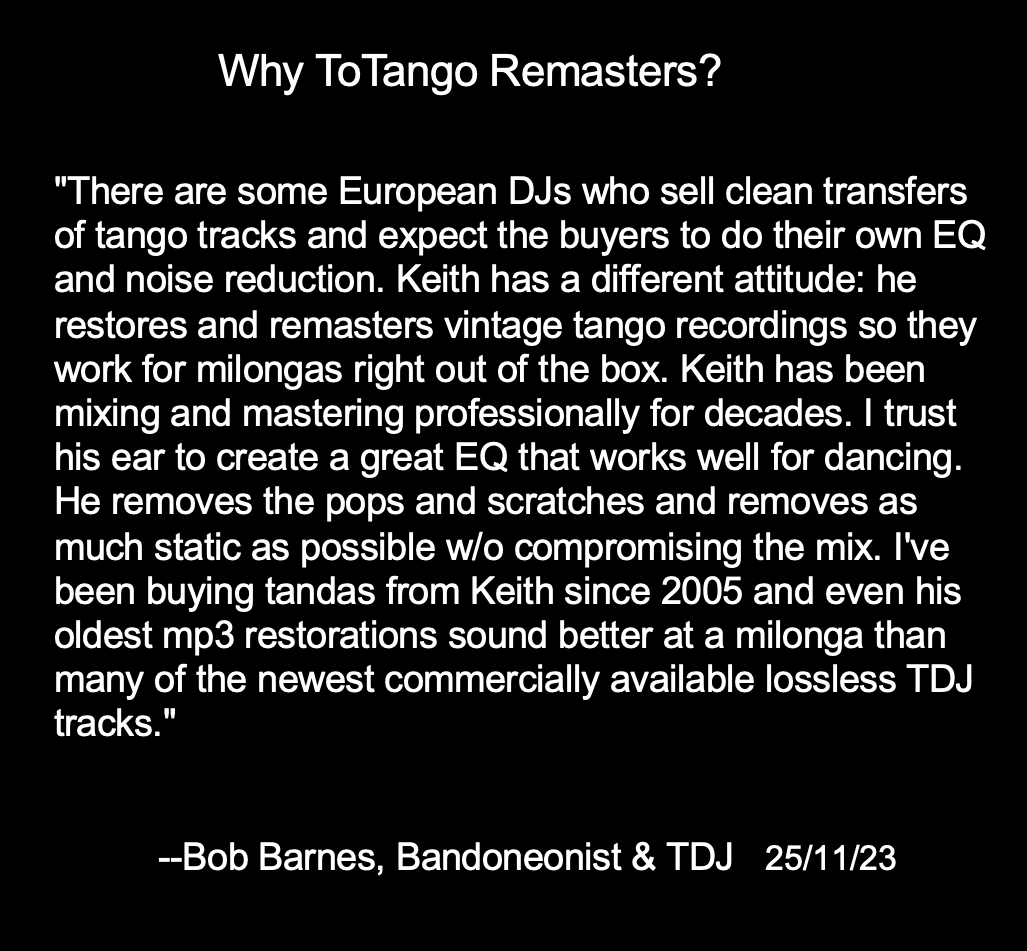
The first email I received in 2008: "Hi Keith - I ordered 5 CDs for my husband's Christmas stocking and my goodness. they are FABULOUS! What a difference compared to our other CDs. We absolutely love what you've done and would like to order more with your 5 CD special for $69."

The last thing I did in 07 was add 60 new Canaro renderings to the ToTANGO RESTORATIONS catalog. Also great additions by D'Arienzo, Laurenz, Troilo, Di Sarli and Lomuto.


And on the subject of recent emails, this from a DJ:

"Hi Keith ­ Going through Troilo, I realized I had 2 versions of 'Orlando Goñi' from 1952. One from the recently released "Archivo TK", and one I got from you awhile back. I wanted to believe that the new release might magically be a bit better but whoa! Wait a minute ... sounds like the typical "goose the bottom end and they will like it" treatment from TK. So listening a few times more, I was easily convinced that yours is better, by far (to discerning ears). I think you had good source material, and you took special care not to mess up the tonality of the piano and bass. Ohhhhhh, the piano sounds delicious on your copy! The whole thing is bright, accurate, with the bass in its proper position and sounding like a musical instrument rather than a fog horn.

So, out goes the TK version, and me with a knowing smirk on my mug as I do it, thinking of you there with your ears laid back tuning that track up a few years ago!!"


read more


Have ToTANGO's Exclusive Restorations In Your Collection!


Tango Conversations
One Way of Looking At It

It's easy to put oneself in a category, noticing that many other dancers are not the same.

We could be new or experienced; like to dance close, or not; prefer nuevo or not, etc.

Here is a category I am in: I don't really enjoy dancing if there is no conversation. By that I mean - both people expressing themselves.


read more


Considering Cortinas
The Dj's Personality Revealed

I've not discussed Cortinas here much, not wanting to criticize others nor reveal what goes into my special bag of tricks. ;-) But, really, with so many new dj's plying the trade, some of the issues ought to be examined and some guiding principles tossed around - for many nights are being diminished by bad cortina choices from amateur dj's.


read more


Tanturi


The Destruction of RCA's Masters
And now - the Details

When RCA destroyed it's Masters of tango recordings 40 years ago, a major reason for our Restoration Project took place.


read more


ToTANGO


Tango Styles and Attitudes

Peter Bengtson's Tango Style table is humourous - and/but full of insight ... a kind of mirror in many respects. Do you see yourself in it?


read more


ToTANGO


The Tango Trance

Seek it, and it will elude you;
Talk about it in too much detail
and it will haunt you evily.
Live for it, and you will die many deaths.

Treasure it, but don't hold onto it.
Dance with love and freedom
and it will embrace you.
Be vulnerable, and feel it's power.

Dan Boccia
Anchorage, AK
tangotrance.blogspot.com


© 1997-2009 Elshaw Communications Inc.
All rights reserved.


The Pillar
 
The Bandoneón
The Immigrant
Bandoneón Affair
 
ToTANGO Best of the Best
Introduction - Criteria
Juan D'Arienzo
Carlos Di Sarli
Francisco Canaro
Osvaldo Pugliese
Miguel Caló
Ricardo Tanturi
Pedro Laurenz
Osvaldo Fresedo
Angel D'Agostino
Aníbal Troilo
Rodolfo Biagi
Enrique Rodriguez
Lucio Demare
Alfredo De Angelis
Edgardo Donato
Francisco Lomuto
Orquesta Típica Victor
 
Astor Piazzolla
 
ToTango Restorations
About Restoration
ToTANGO CD's 
DJ Forum
Guest DJ's
Keith's DJ Musings
 
Book Reviews
Piazzolla - A Memoir
An Anxious Quest For Freedom - The Dinzels
 
Plus
Julian Plaza
Alberto Castillo
Hernán Obispo
Domingo Federico
Elvino Vardaro
3 Women
Assassination Tango
The Beat of Montréal
Tango Lessons
Miami Tango Fantasy
Tango-L
Buenos Aires Tips
More Tango Thoughts
 
Today's Argentina News
 
ToTANGO Links


  Click for Montreal, Quebec Forecast